 Terraria Wiki Fieldbook
terraria class guide: a step-by-step route from first pick to Moon Lord
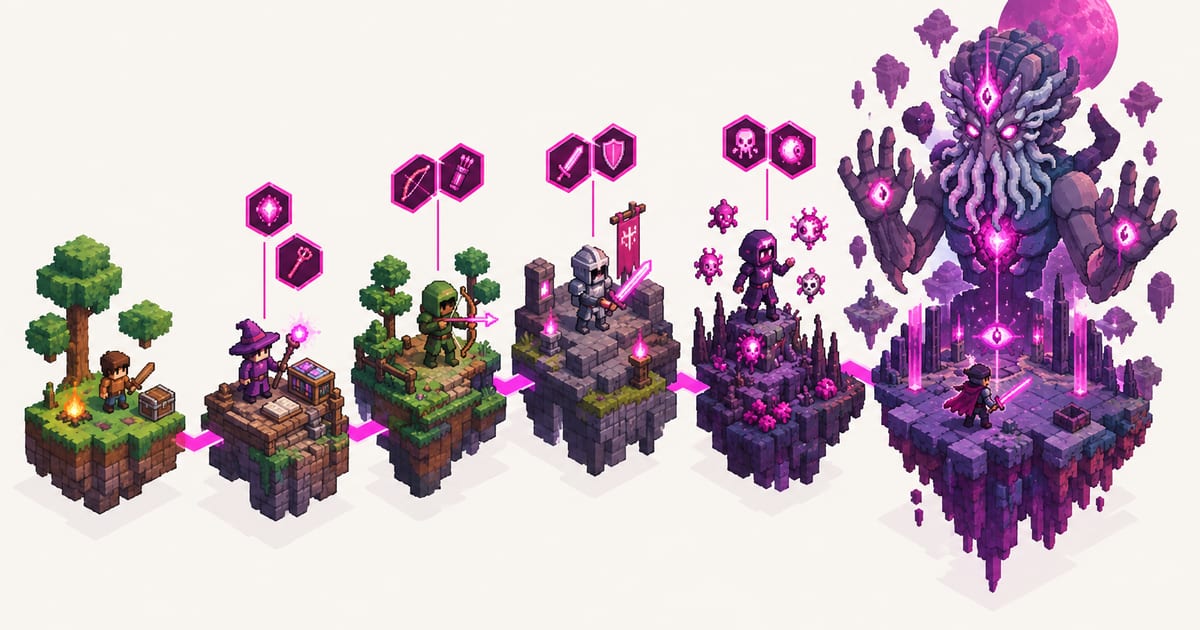
A good terraria class guide should do more than list armor sets. It should tell you what to do first, what to skip, and when to change your plan. This walkthrough treats classes as a progression choice: you pick a primary damage type, build around it, and adjust as bosses demand. The goal is not to lock you into one weapon forever. It is to stop you from spreading ore, coins, and accessory slots across four damage types at once. Below is the route I use when a run starts to feel scattered, followed by the mistakes that waste the most time.
What a class actually means in Terraria
Terraria does not have a locked class system. Any character can use any weapon. What people call a class is a bundle of gear that boosts one damage type: melee, ranged, magic, or summon. Armor sets, accessories, and prefixes push you toward one lane. A melee helmet boosts melee damage, a mage set restores mana, and so on. You can still carry a sword for emergencies. The point is to make most of your damage come from one type so your gear multiplies itself instead of fighting itself.
That distinction matters because it changes how you spend resources. A focused run spends ore on one armor path, reforges accessories for one damage type, and only farms weapons that fit the plan. A casual run can mix and match, but it will feel weaker at the same stage unless you overgear.
terraria class guide: step-by-step progression
Step 1: Pick a primary damage type before the first boss
The first rule of any terraria class guide is to choose one lane early. Write down one damage type and stick with it until the next major gate. Melee is forgiving because swords and yoyos do not need ammo or mana. Ranged keeps distance and uses ammo, which means a steady crafting habit. Magic is bursty and mana-hungry but has strong crowd control. Summon is fragile early and rewards preparation; you let minions work while you dodge. None of these is a wrong answer. The wrong answer is trying to fund all four at once.
If you are undecided, pick the class whose first good weapon you already found. A lucky drop is a better tiebreaker than a forum argument.
Step 2: Build a base that supports the class
A compact base with valid NPC housing is not cosmetic. It keeps vendors close, gives you a place to stash class-specific gear, and shortens the walk between crafting stations. Put chests next to the station that uses them: ores by the furnace, potions by the alchemy table, weapons by the tinkerer. If NPCs are spread across the map, you will waste more time than you expect. See terraria housing for room rules and layouts that still look like a house.
Keep one class chest per damage type even if you only play one. You will find off-class gear, and storing it beats selling it by accident.
Step 3: Gear for the first few bosses without overfarming
Use the best weapon you can craft or find for your chosen type, then stop. Early bosses punish bad movement more than low damage. Fill accessory slots with mobility first: boots, double jump, and something that helps you dash or grapple. Then add damage. A glass cannon with no dash will lose to a boss with a simple pattern.
Check a progression list before you spend hours farming. The terraria bosses guide is useful for order and prerequisites, not just fight tips. If a weapon requires a rare drop from an enemy you hate, use the next-best option and move on.
Step 4: Build an arena before you need it
Every class benefits from flat ground, several layers of platforms, campfires, heart lanterns, and a honey pool. Leave gaps for vertical movement. Put a bed nearby so death costs seconds, not minutes. For magic and ranged, add clear sightlines. For melee, add enough floor to close distance without falling into a pit. For summon, add space to kite while minions chip away.
Do not decorate the arena until after the boss dies. Function first.
Step 5: Treat the Wall of Flesh as a class checkpoint
The Wall of Flesh is the point where a loose build becomes expensive. Before you summon it, your chosen class should have a clear weapon, a damage accessory or two, and enough mobility to dodge in a straight line. Build a long bridge, clear obstructions, and bring potions. This is also the last easy moment to fix a mixed build. After Hardmode starts, ore and souls are too valuable to split four ways.
The terraria wall of flesh page covers summoning and arena setup in more detail. Read it before you build the bridge, not after.
Step 6: Choose a Hardmode lane and specialize
Early Hardmode is a gear reset. Pick the armor set that matches your class and accept that it may look worse than your old mixed set. It will scale better. Spend your first Hardmode ores on that set, then on the weapon that fits your damage type. Do not craft every armor set just in case. You can always farm more ore later.
This is where a terraria class guide earns its keep: it tells you what to ignore. Ignore the shiny weapon from another class unless it solves a specific problem. Ignore reforges that boost the wrong damage type. Ignore the urge to wear a hybrid set because it has one good bonus.
Step 7: Fix accessories, reforging, and potions
Accessories are half your build. Use the Goblin Tinkerer to reforge toward your damage type or defense, but do not chase perfect prefixes on gear you will replace tomorrow. A mid-tier prefix on the right accessory beats a perfect prefix on the wrong one. Keep a charm or two for mobility, one for defense, and the rest for damage.
Potions are not optional at boss level. Ironskin, regeneration, and swiftness help every class. Damage-specific potions help your lane. Mana potions are mandatory for magic; ammo conservation or ammo crafting matters for ranged. If you are low on ingredients, fishing is the least glamorous fix. The terraria fishing rods page explains which rods are worth the effort.
Step 8: Practice one or two boss-specific swaps
A pure build is a baseline, not a religion. Swapping one accessory or one weapon for a fight is fine. The mistake is rebuilding your whole character for every boss. Pick swaps that solve a mechanic: more mobility for a fast boss, more defense for a fight you barely survive, a summon for passive damage while you dodge. Then swap back.
Common mistakes in a terraria class guide run
Most terraria class guide failures are resource problems, not skill problems. Here are the ones I see most often:
- Funding four classes at once. Every ore, coin, and accessory slot spent on an off-class weapon is a slot not multiplying your main damage. Sell or store the rest.
- Skipping mobility for damage. A dead character does zero DPS. Boots and a dash are not wasted slots.
- Overfarming a single drop. If a weapon has a low drop rate, set a limit. Use the next option and come back when the boss is easier.
- Building an arena after the first failure. Build it before. The fight is hard enough without fighting your own terrain.
- Ignoring potions and buffs. A five-minute potion batch changes a fight more than one extra point of damage.
- Wearing a hybrid set because it has one good stat. Class sets usually win once you have the right weapon.
- Forgetting summons exist. Even non-summoners can keep a minion out for chip damage. It costs one slot and a summoning staff.
Tips that make any class smoother
- Label chests by class and stage. Mage pre-Hardmode is more useful than stuff.
- Keep a target dummy near your base and test new weapons before a boss. Damage feel matters more than a tooltip.
- Bind quick heal and quick mana to keys you can hit without looking.
- Save one panic accessory for defense or dodge, even on a damage build.
- Do not sell old class gear until you have replaced it twice. Progression is lumpy.
- If a boss feels impossible, change one variable at a time: arena, accessory, potion, weapon. Randomly changing everything teaches you nothing.
- Check exact drop rates, set bonuses, and crafting trees on the wiki when a plan depends on them. This site is a fieldbook, not a database.
A terraria class guide is only useful if it gets you past the next boss and into the next stage without wasting a weekend. Pick one lane, build the support structure around it, and adjust one variable at a time. The class you choose matters less than the discipline you bring to gearing it. When the run starts to sprawl again, come back to these steps and cut the extras.
Frequently Asked Questions
What is the easiest class for a first Terraria run?
Melee is usually the most forgiving first pick because it does not need ammo or mana, and early swords are easy to find. Ranged is also comfortable if you remember to craft ammo. Summoner is the least forgiving early because minions are fragile and gear-dependent. Pick the class whose weapon you already enjoy using; comfort beats tier lists.
Can I switch classes in the middle of a world?
Yes. Nothing locks you in. Switching costs time and resources, so do it at a natural break like after a boss or at the start of Hardmode. Keep the old gear in a labeled chest instead of selling it. If you switch often, build one arena and one base that work for every class.
Do I need to pick a class before Hardmode?
You can delay the decision, but Hardmode is where mixed builds start to hurt. Ore, souls, and accessory slots become more expensive to split. Pick a primary damage type before the Wall of Flesh, then specialize early in Hardmode. You can still change later; it just costs more farming.
Which class is best for boss fights?
There is no permanent winner. Ranged and magic are safer at range, melee is durable with the right armor, and summoner deals passive damage while you dodge. The best class is the one you can play without panicking. Check boss-specific guides for resistances, arena needs, and weapon options before committing.